
Japanese Excavators vs Korean Excavators: Which Is the Smarter Choice in the Global Used Market?
Introduction
When shopping for a used excavator, buyers often find themselves comparing two of the world's most respected manufacturing countries: Japan and South Korea. Both have built strong reputations in the global construction equipment industry, yet their machines are designed with different philosophies and appeal to different types of users.
Japanese excavators are widely recognized for their exceptional reliability, refined hydraulic systems, long service life, and high resale value. They have dominated the international used equipment market for decades and continue to be the first choice for many contractors, rental companies, and equipment dealers.
Korean excavators, on the other hand, have developed rapidly over the past two decades. Manufacturers such as Hyundai and DEVELON (formerly Doosan) have invested heavily in technology, engine efficiency, operator comfort, and product quality. Today, Korean excavators are considered serious competitors, offering excellent performance at a more competitive price point.
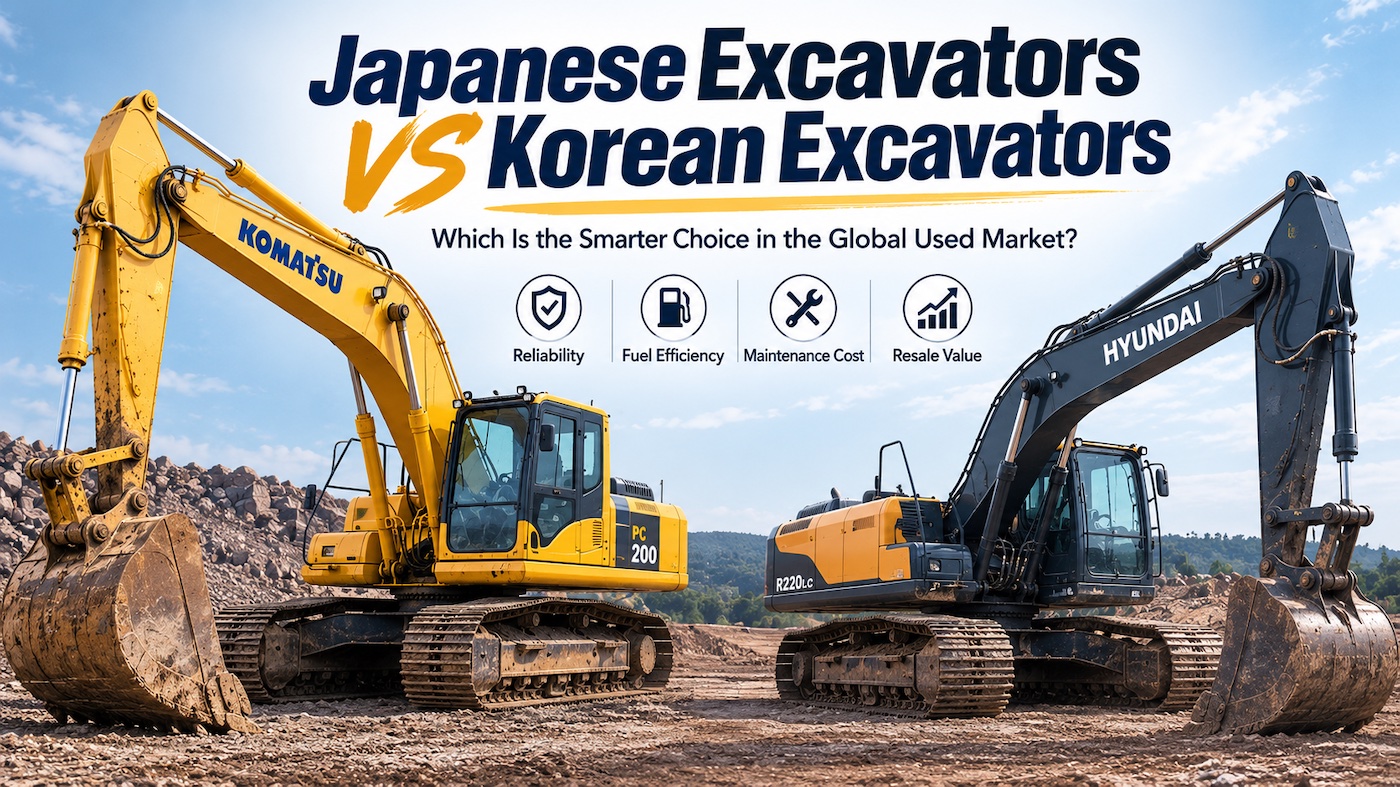
So, which is the smarter investment in today's global used market?
The answer depends on several factors, including your budget, operating environment, maintenance capability, spare parts availability, and long-term ownership goals. A machine that performs exceptionally well on a large infrastructure project may not necessarily be the best option for a small contractor or equipment rental business.
This guide provides an objective comparison of Japanese and Korean excavators from the perspective of the global used equipment market. Rather than promoting one country over the other, we'll examine how they compare in terms of reliability, operating costs, fuel efficiency, maintenance, resale value, and the most popular models. By the end of this guide, you'll have a clearer understanding of which type of excavator best fits your business and working conditions.
Why Japanese and Korean Excavators Dominate the Global Used Market
Although construction equipment is manufactured in many countries, the global used excavator market is overwhelmingly dominated by Japanese and Korean brands. Whether you visit equipment auctions in Japan, dealers in the Middle East, contractors in Africa, or construction companies in South America, machines from these two countries consistently represent a significant share of the available inventory.
Japanese manufacturers entered the global excavator market earlier and established an outstanding reputation through decades of engineering innovation and product reliability. Since the 1970s and 1980s, brands like Komatsu, Hitachi, and Kobelco have been exported to virtually every major construction market. Their machines became known for dependable performance, precise hydraulic systems, and the ability to operate efficiently even after many thousands of working hours.
Because of this long history, there is now a massive global supply of Japanese used excavators. Many machines remain in good operating condition after 10 to 20 years of service, making them highly attractive to buyers looking for proven equipment at a lower cost than new models.
South Korea entered the international construction equipment industry later but expanded rapidly during the 1990s and 2000s. Companies such as Hyundai and Doosan (now DEVELON) focused on combining modern technology with competitive pricing. Continuous investment in research and development allowed Korean excavators to narrow the performance gap with Japanese competitors while maintaining an attractive price advantage.
Today, Korean excavators are increasingly popular in developing markets where buyers seek newer machines with modern features but still need to control acquisition costs. Improvements in engine technology, hydraulic systems, operator comfort, and product durability have significantly strengthened their position in the global used equipment market.
Another important reason both countries dominate the used market is the extensive international support network built around their equipment. Spare parts, aftermarket components, experienced technicians, and maintenance knowledge are readily available in most regions, reducing ownership risk for buyers.
As a result, the purchasing decision today is rarely about choosing between a "good" and a "bad" excavator. Instead, buyers are deciding between two mature equipment ecosystems that offer different advantages depending on budget, application, and long-term operating strategy.
Major Japanese Excavator Brands
Japan is home to some of the most respected construction equipment manufacturers in the world. Their excavators are generally positioned as premium products, emphasizing durability, engineering precision, fuel efficiency, and long-term ownership value.
Below are the major Japanese brands commonly found in today's global used market.
| Brand | Market Position | Popular Used Models |
| Komatsu | Global industry leader with excellent durability and resale value | PC78US, PC130, PC138US, PC200, PC210, PC220, PC240, PC300, PC350, PC360 |
| Hitachi | Industry-leading hydraulic performance and smooth operation | ZX70, ZX120, ZX130, ZX135, ZX200, ZX210, ZX240, ZX330, ZX350 |
| Kobelco | Known for fuel efficiency and refined hydraulics | SK75, SK140, SK200, SK210, SK250, SK260, SK350 |
| Sumitomo | Reliable hydraulic technology with stable performance | SH120, SH210, SH240, SH350 |
| Kubota | Global leader in compact excavators | U30, U35, KX057, KX080 |
| Yanmar | Premium mini excavator manufacturer | ViO35, ViO55, ViO80 |
| Takeuchi | Pioneer in compact excavators with exceptional durability and lifting performance | TB216, TB225, TB230, TB260, TB290 |
| KATO | Well-known for medium-sized construction equipment | HD512, HD820, HD1023 |
Among all Japanese models, the Komatsu PC200, Hitachi ZX200, and Kobelco SK200 are arguably the three most widely traded 20-ton excavators in the international used market. Their popularity stems from an excellent balance of reliability, fuel economy, productivity, and parts availability.
Mini excavators from Kubota and Yanmar also enjoy a strong reputation in Europe, North America, and Southeast Asia, where compact machines are frequently used for landscaping, municipal work, and urban construction.
Takeuchi is another highly respected Japanese manufacturer specializing in compact excavators. Known for its rugged build quality, excellent lifting capacity, and operator-friendly design, Takeuchi machines have earned a loyal following in Europe and North America. Popular models such as the TB216, TB225, TB230, TB260, and TB290 are widely used in landscaping, utility work, residential construction, and equipment rental fleets.
Overall, Japanese brands are often viewed as a long-term investment. While their purchase prices are usually higher than comparable Korean machines, they tend to maintain stronger resale values and lower depreciation over time.
Major Korean Excavator Brands
South Korea has fewer excavator manufacturers than Japan, but its leading brands have become major players in the international construction equipment industry. Korean excavators are generally recognized for offering strong performance, modern technology, and competitive pricing, making them an attractive choice for buyers seeking value without sacrificing productivity.
The two dominant Korean brands in today's used market are:
| Brand | Market Position | Popular Used Models |
| Hyundai | Excellent value with continuous product improvements | R80, R140LC, R215LVS, R220LC, R305LC, R380LC |
|
DEVELON (Formerly Doosan) |
Heavy-duty construction and mining applications | DX140LC, DX225LC, DX235LCR, DX300LC, DX420LC, DX500LC |
Hyundai has steadily expanded its global market share by introducing more fuel-efficient engines, improved operator cabins, and upgraded hydraulic systems. The R220LC has become one of the company's flagship 20-ton excavators and is commonly seen across Asia, Africa, and the Middle East.
DEVELON, formerly known as Doosan, has long been recognized for building robust machines capable of handling demanding working conditions. Models such as the DX225LC and DX300LC are particularly popular in quarry operations, infrastructure projects, and heavy earthmoving applications where durability and digging power are essential.
Compared with Japanese manufacturers, Korean brands generally place greater emphasis on providing competitive purchase prices and attractive standard equipment. As product quality has improved over recent years, they have become increasingly appealing to contractors looking for relatively newer machines at reasonable prices.
While Korean excavators may not always command the same resale premiums as their Japanese counterparts, their combination of modern design, lower acquisition costs, and solid overall performance has earned them a growing share of the global used equipment market.
Reliability: Which Lasts Longer?
Reliability is often the first factor buyers consider when purchasing a used excavator, especially when the machine is expected to operate thousands of additional hours after purchase.
For decades, Japanese excavators have built an exceptional reputation for long-term durability. Manufacturers such as Komatsu, Hitachi, Kobelco, and Sumitomo have consistently focused on engineering quality rather than simply increasing specifications. Their hydraulic systems are known for smooth operation, structural components are designed for long service life, and engines often remain dependable even after high operating hours when properly maintained.
It is not uncommon to find Japanese excavators with 15,000 to 20,000 working hours still performing reliably in construction, mining, and infrastructure projects. This proven longevity is one of the main reasons Japanese machines continue to command higher prices in the used market.
Korean excavators have also made remarkable progress. Earlier generations sometimes faced criticism regarding hydraulic refinement and long-term durability, but modern Hyundai and DEVELON machines have significantly narrowed the gap. Improvements in engine technology, hydraulic control systems, manufacturing quality, and component reliability have made today's Korean excavators far more competitive than they were a decade ago.
For machines with relatively low to moderate operating hours, the reliability difference between modern Japanese and Korean excavators is often smaller than many buyers assume. In normal construction applications, both are capable of delivering dependable performance when properly serviced.
However, when comparing machines that have accumulated very high working hours or have been used under severe operating conditions, Japanese excavators generally maintain a stronger reputation for long-term durability. Their consistent engineering quality and established maintenance record continue to give them an advantage among contractors who prioritize maximum service life and higher resale value.
That said, reliability ultimately depends on more than the country of manufacture. A well-maintained Korean excavator with complete service records is often a better investment than a poorly maintained Japanese machine. Buyers should always evaluate the individual condition of the equipment, including maintenance history, hydraulic performance, structural wear, engine condition, and previous operating environment, rather than relying solely on brand reputation.
Hydraulic Performance: Precision vs Practical Power
Hydraulic performance is one of the most important factors influencing an excavator's productivity. A well-designed hydraulic system determines how smoothly the machine responds, how precisely the operator can control attachments, and how efficiently power is delivered to the boom, arm, and bucket.
Japanese excavators have long been regarded as the benchmark for hydraulic refinement. Manufacturers such as Hitachi, Kobelco, Komatsu, and Sumitomo have spent decades optimizing hydraulic efficiency, resulting in smooth multi-function operation and precise control. Operators often notice that Japanese machines allow simultaneous movements—such as boom lifting, arm extension, bucket curling, and swing rotation—to remain well balanced without feeling sluggish or jerky. This level of control is especially valuable for grading, trenching, utility work, and other applications requiring high precision.
Among Japanese brands, Hitachi ZX Series excavators are widely recognized for their responsive hydraulic systems and excellent controllability, while Kobelco SK Series machines have earned a strong reputation for combining smooth operation with impressive fuel efficiency.
Korean excavators have made significant progress over the last decade. Modern Hyundai R-Series and DEVELON DX-Series machines feature advanced hydraulic systems that deliver higher digging force, faster cycle times, and improved responsiveness compared with earlier generations. For heavy excavation, loading trucks, demolition, and quarry work, many contractors appreciate the strong breakout force and robust hydraulic output offered by Korean models.
For most contractors, the practical performance difference between newer Japanese and Korean excavators is relatively small. However, experienced operators who frequently perform fine grading or precision excavation often continue to prefer Japanese hydraulic systems for their smoother feel and more predictable control.
Ultimately, hydraulic performance is no longer a decisive advantage for one country alone. Instead, buyers should compare individual models and machine condition, particularly on used equipment where maintenance history can have a greater impact than original factory specifications.
Fuel Efficiency: Saving Costs Over Thousands of Hours
Fuel represents one of the largest operating expenses throughout an excavator's working life. Even a modest improvement in fuel efficiency can translate into significant savings after thousands of operating hours.
Japanese manufacturers have traditionally prioritized fuel economy alongside productivity. Rather than simply increasing engine output, brands such as Komatsu, Hitachi, and Kobelco have focused on improving hydraulic efficiency, optimizing engine control systems, and reducing unnecessary fuel consumption during everyday operation.
Among them, Kobelco is widely recognized for producing some of the most fuel-efficient excavators in the industry. Its SK Series has consistently been praised for achieving excellent productivity while maintaining relatively low fuel consumption.
Komatsu's advanced engine management systems and hydraulic optimization also contribute to impressive fuel economy, particularly in the popular PC200 and PC210 series.
Korean manufacturers have narrowed the gap considerably in recent years. Modern Hyundai and DEVELON excavators equipped with electronically controlled engines offer much better fuel efficiency than previous generations. Their intelligent work modes allow operators to balance performance and fuel consumption based on the jobsite requirements.
In real-world operation, however, the difference in fuel consumption between comparable Japanese and Korean excavators is usually not dramatic. Factors such as operator habits, machine maintenance, working conditions, and attachment selection often have a greater influence on fuel usage than the country of manufacture.
For buyers planning long-term ownership, selecting a well-maintained excavator with a healthy engine and hydraulic system is generally more important than focusing solely on published fuel consumption figures.
Maintenance Costs and Spare Parts Availability
Maintenance costs are another key consideration when purchasing a used excavator. Even a machine with an attractive purchase price can become expensive if replacement parts are difficult to obtain or major repairs occur frequently.
Japanese excavators benefit from decades of global distribution. Because millions of Komatsu, Hitachi, Kobelco, Kubota, and Yanmar machines are operating worldwide, both genuine and aftermarket replacement parts are widely available. Many independent repair workshops are also familiar with Japanese equipment, making routine maintenance relatively straightforward in most countries.
The Komatsu PC200 and Hitachi ZX200, for example, have become industry standards in many regions. Their popularity means filters, seals, undercarriage components, hydraulic pumps, and engine parts can often be sourced quickly from multiple suppliers.
Korean excavators have also established increasingly strong parts networks. Hyundai and DEVELON have expanded their dealer and service coverage across Asia, Africa, the Middle East, and Latin America, improving parts availability compared with the past. Common service items are generally easy to obtain, although availability for certain specialized components may still vary depending on the local market.
Routine maintenance costs between Japanese and Korean excavators are generally comparable. Regular servicing—including engine oil, hydraulic oil, filters, and undercarriage maintenance—follows similar schedules across most brands.
The biggest difference often appears in long-term ownership. Japanese excavators are widely recognized for maintaining stable performance as operating hours increase, potentially reducing the frequency of major component repairs over their lifetime. Korean excavators, meanwhile, often compensate through lower initial purchase prices, giving buyers greater flexibility within a fixed budget.
Before purchasing any used excavator, buyers should investigate local parts availability and service support. A machine with strong dealer coverage in one country may be less practical in another where spare parts are limited or expensive.
Purchase Price: How Much Can You Save?
Purchase price is often the deciding factor for buyers entering the used excavator market.
Generally speaking, Japanese excavators command higher prices than comparable Korean models due to their strong reputation, higher demand, and excellent resale value.
For example, under similar age, condition, and operating hours:
A Komatsu PC200 or Hitachi ZX200 will typically cost more than a comparable Hyundai R220LC or DEVELON DX225LC.
Premium Japanese brands such as Kobelco also tend to maintain relatively strong market values.
Korean excavators usually offer newer model years or lower operating hours within the same budget.
This pricing difference creates two distinct purchasing strategies.
Buyers who prioritize long-term reliability, resale value, and established market acceptance often choose Japanese excavators despite the higher initial investment.
Buyers working within tighter budgets may find Korean excavators more attractive, as they can often purchase a newer machine with more modern features for the same amount of money.
Rather than asking which country offers the cheapest excavator, a more useful question is which machine provides the best overall value throughout its entire service life.
Total Cost of Ownership: Looking Beyond the Purchase Price
Experienced equipment buyers rarely evaluate an excavator based solely on its purchase price. Instead, they consider the Total Cost of Ownership (TCO)—the combined cost of buying, operating, maintaining, repairing, and eventually selling the machine.
A lower-priced excavator may appear attractive initially, but if it consumes more fuel, requires frequent repairs, or loses value quickly, its long-term ownership cost may exceed that of a more expensive machine.
Japanese excavators generally perform well in this area because they combine reliable performance, relatively low downtime, strong parts availability, and excellent resale value. These advantages often offset their higher purchase prices over many years of operation.
Korean excavators, meanwhile, may provide excellent overall value for contractors with limited capital or those planning shorter ownership periods. Lower acquisition costs allow businesses to expand their fleets while maintaining financial flexibility.
Ultimately, the smartest purchasing decision depends on how the excavator will be used. A contractor expecting to operate a machine intensively for the next ten years may reach a different conclusion than a dealer purchasing equipment for resale or a rental company seeking to maximize return on investment.
Resale Value: Which Excavators Hold Their Value Better?
Resale value is often overlooked when purchasing a used excavator, yet it has a significant impact on the machine's overall ownership cost. Contractors who frequently upgrade equipment, dealers who rely on inventory turnover, and rental companies managing fleet depreciation all benefit from machines that retain their market value.
In general, Japanese excavators continue to lead the global used market in resale value. Their long-established reputation for reliability, extensive service history, and worldwide parts availability make them easier to resell across different regions. Buyers are often willing to pay a premium for machines they trust, particularly when maintenance records are available.
Among Japanese brands, Komatsu consistently achieves some of the strongest resale values. Models such as the PC200, PC210, and PC300 remain highly sought after due to their proven durability and global popularity. Hitachi ZX200 and ZX210 also perform exceptionally well in the second-hand market, while Kobelco SK200 and SK210 maintain stable demand thanks to their fuel-efficient operation.
Korean excavators have also shown improving resale performance over the past decade. As Hyundai and DEVELON continue expanding their global presence, buyer confidence has increased, particularly for newer-generation machines. However, depreciation is generally still higher than comparable Japanese equipment, especially in regions where Japanese brands dominate local fleets.
For buyers planning to sell or trade in their excavator after several years, resale value should be considered alongside the initial purchase price. Paying slightly more for a machine that depreciates more slowly may ultimately result in a lower total cost of ownership.
Regional Market Preferences
Buying trends vary considerably from one region to another. Local contractor preferences, parts availability, dealer networks, and historical brand presence all influence which excavators perform best in the used market.
Africa
Africa remains one of the largest destinations for used excavators. Japanese brands dominate many countries because of their long-standing reputation for reliability and the widespread availability of spare parts.
The most common models include:
Komatsu PC200 / PC210
Hitachi ZX200 / ZX210
Kobelco SK200 / SK210
Hyundai and DEVELON have gradually expanded their presence in recent years, particularly on infrastructure and mining projects where competitive pricing is an important advantage.
Southeast Asia
Southeast Asia represents one of the most diverse excavator markets in the world.
Japanese excavators remain highly respected, especially Komatsu, Hitachi, Kobelco, Kubota, and Yanmar. Compact excavators from Kubota and Takeuchi are particularly popular for urban construction and landscaping.
Korean excavators also enjoy strong market acceptance, especially Hyundai, which has built an extensive dealer network across several countries.
Middle East
Large infrastructure projects, quarry operations, and demanding desert environments require durable equipment.
Japanese brands continue to maintain an excellent reputation, while DEVELON has gained popularity in heavy-duty applications due to its robust construction and powerful digging performance.
Latin America
Price sensitivity plays a significant role throughout Latin America.
Many buyers compare Japanese reliability against Korean affordability. Hyundai excavators have gained market share by offering modern equipment at competitive prices, while Komatsu and Hitachi continue to dominate among contractors seeking maximum long-term reliability.
Eastern Europe and CIS Countries
Construction companies in Eastern Europe and CIS markets continue to rely heavily on Japanese excavators because of their proven performance and mature service networks.
At the same time, Korean excavators have become increasingly common as contractors seek newer equipment within fixed budgets.
Overall, Japanese excavators generally enjoy broader global acceptance, while Korean excavators continue expanding their presence through improved product quality and competitive pricing.
Most Popular Used Excavator Models by Size Class
Although every contractor has unique requirements, certain models consistently stand out in the global used market because of their proven reliability, strong parts support, and high resale value.
Mini Excavators (1–6 Tons)
Japanese Brands
Kubota U30
Kubota KX057
Kubota KX080
Yanmar ViO35
Yanmar ViO55
Yanmar ViO80
Takeuchi TB225
Takeuchi TB230
Takeuchi TB260
Korean Brands
Hyundai R35Z
Hyundai R60CR
Japanese manufacturers clearly dominate the global compact excavator market, particularly in Europe and North America.
Medium Excavators (13–25 Tons)
This is the most competitive segment worldwide and accounts for a large share of international used excavator transactions.
Japanese Brands
Komatsu PC138US
Komatsu PC200
Komatsu PC210
Hitachi ZX200
Hitachi ZX210
Kobelco SK200
Kobelco SK210
Sumitomo SH210
Korean Brands
Hyundai R215LVS
Hyundai R220LC
DEVELON DX225LC
DEVELON DX235LCR
These machines are widely used for road construction, earthmoving, municipal engineering, and general contracting.
Large Excavators (30 Tons and Above)
Large excavators are primarily used for mining, quarrying, heavy earthmoving, and large-scale infrastructure projects.
Japanese Brands
Komatsu PC300
Komatsu PC360
Hitachi ZX330
Hitachi ZX350
Kobelco SK350
Sumitomo SH350
Korean Brands
Hyundai R305LC
Hyundai R380LC
DEVELON DX300LC
DEVELON DX420LC
DEVELON DX500LC
In this category, Korean excavators have become increasingly competitive, particularly in applications requiring high digging force and lower acquisition costs.
Which Excavator Fits Different Applications?
Instead of asking which country manufactures the "best" excavator, buyers should consider which machine is best suited to their intended application.
General Construction
Both Japanese and Korean excavators perform well in general construction.
If precision and fuel efficiency are priorities, Japanese machines often have a slight advantage.
If budget is more important, Korean excavators provide excellent value.
Road Construction
Komatsu, Hitachi, Hyundai, and DEVELON all offer reliable machines for road projects.
The choice usually depends more on local service support than on machine capability.
Quarry and Mining
Heavy-duty applications place greater demands on structural strength and hydraulic power.
Popular choices include:
Komatsu PC300
Hitachi ZX350
DEVELON DX420
DEVELON DX500
Hyundai R380
Municipal and Utility Work
Compact excavators from Kubota, Yanmar, and Takeuchi remain industry favorites because of their compact dimensions, low fuel consumption, and excellent maneuverability.
Equipment Rental
Rental companies typically prioritize machines with broad market acceptance, reliable performance, and strong resale value.
For this reason, Komatsu PC200, Hitachi ZX200, and Kobelco SK200 continue to rank among the most desirable models for rental fleets in many regions.
Buying Tips for the Used Market
Regardless of whether you choose a Japanese or Korean excavator, the condition of the individual machine is often more important than its country of origin.
Before making a purchase, buyers should carefully inspect:
Service and maintenance records
Engine performance and cold-start condition
Hydraulic pump pressure and response
Boom, arm, and bucket pin wear
Swing bearing and travel motors
Undercarriage wear
Structural welds and frame condition
Hour meter consistency
Signs of previous major repairs or accident damage
Whenever possible, conduct a functional test under working conditions. A well-maintained excavator with slightly higher operating hours is often a safer investment than a neglected machine with a lower hour meter reading.
Japanese vs Korean Excavators: Advantages and Disadvantages
After comparing reliability, hydraulic performance, fuel efficiency, maintenance costs, resale value, and market popularity, one thing becomes clear: there is no universal "best" excavator. The right choice depends on your budget, working conditions, and long-term ownership plans.
The table below summarizes the key strengths and trade-offs of Japanese and Korean excavators.
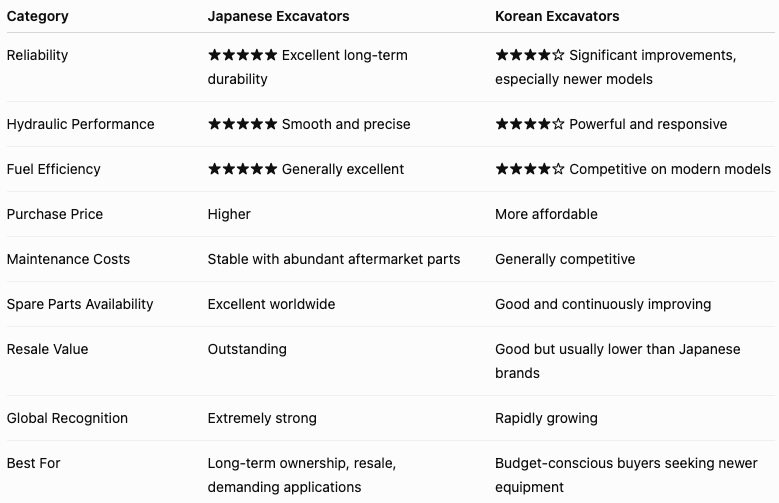
Overall, Japanese excavators continue to set the benchmark for reliability and long-term ownership value, while Korean excavators offer an attractive balance between performance and affordability.
Which Buyers Should Choose Japanese Excavators?
Japanese excavators are generally the better option if you:
Plan to keep the machine for many years.
Prioritize long-term reliability over initial purchase price.
Work in remote areas where unexpected downtime can be costly.
Value strong resale performance.
Require precise hydraulic control for finishing work or utility projects.
Operate a rental fleet where trusted brands attract more customers.
Popular choices include:
Komatsu PC200 / PC210 / PC300
Hitachi ZX200 / ZX210 / ZX350
Kobelco SK200 / SK210 / SK350
Kubota KX080
Takeuchi TB260
Although these machines often require a larger initial investment, many owners recover part of that cost through lower depreciation and strong resale demand.
Which Buyers Should Choose Korean Excavators?
Korean excavators are an excellent choice if you:
Have a limited equipment budget.
Prefer purchasing a newer machine for the same investment.
Mainly perform general construction, earthmoving, or road work.
Have reliable Hyundai or DEVELON dealer support in your region.
Want modern features without paying premium Japanese prices.
Popular models include:
Hyundai R215LVS
Hyundai R220LC
Hyundai R305LC
DEVELON DX225LC
DEVELON DX300LC
DEVELON DX420LC
For many contractors, Korean excavators represent an excellent balance between purchase price, productivity, and operating costs.
Common Misconceptions About Japanese and Korean Excavators
When comparing used excavators, several misconceptions frequently appear in online discussions and buyer conversations.
"Japanese excavators are always better."
Not necessarily.
While Japanese manufacturers have earned an outstanding reputation over several decades, modern Korean excavators have improved dramatically in terms of engineering, reliability, and operator comfort. A well-maintained Hyundai or DEVELON may outperform a neglected Japanese machine with poor maintenance history.
"Korean excavators are only popular because they're cheaper."
Price is certainly an advantage, but it is no longer the only reason contractors choose Korean equipment.
Recent generations of Hyundai and DEVELON excavators offer impressive hydraulic performance, fuel efficiency, and operator comfort. Their growing market share reflects genuine improvements in product quality as well as competitive pricing.
"Higher operating hours automatically mean higher risk."
Operating hours provide useful information, but they do not tell the whole story.
A properly serviced excavator with 12,000 hours can often be a safer purchase than a poorly maintained machine showing only 6,000 hours. Maintenance records, component condition, and inspection results should always carry more weight than the hour meter alone.
How to Make the Right Buying Decision
Rather than choosing a machine based solely on country of origin, evaluate each excavator from multiple perspectives.
Consider asking yourself the following questions:
How many hours will the machine operate each year?
Will it be used for heavy excavation, road construction, mining, or light utility work?
Is there reliable local support for parts and service?
How long do you plan to keep the machine?
Is resale value an important consideration?
Does your budget prioritize lower purchase cost or lower lifetime ownership cost?
Answering these questions will usually narrow the selection much more effectively than comparing brand names alone.
Final Thoughts
Japanese and Korean excavators have each established strong positions in today's global used market, but they appeal to different priorities.
Japanese brands—including Komatsu, Hitachi, Kobelco, Sumitomo, Kubota, Yanmar, KATO, and Takeuchi—continue to be recognized for their proven durability, refined hydraulic systems, excellent fuel efficiency, and outstanding resale value. For buyers focused on long-term ownership and maximum reliability, they remain among the safest investments available.
Korean manufacturers such as Hyundai and DEVELON have made remarkable progress over the past decade. Modern models deliver strong performance, competitive fuel economy, improved operator comfort, and attractive pricing, making them an increasingly popular choice for contractors seeking excellent value.
Ultimately, the smartest choice is not determined by whether an excavator was built in Japan or South Korea—it depends on how well the machine matches your operational needs, maintenance capabilities, and investment goals. A carefully inspected, well-maintained excavator that fits your workload will almost always provide better value than simply choosing a machine based on its country of manufacture.
Before making a purchase, compare the machine's overall condition, service history, operating hours, and local parts support. Taking the time to evaluate these practical factors will help ensure that your investment delivers reliable performance and long-term value in the global used market.
2026-07-20