
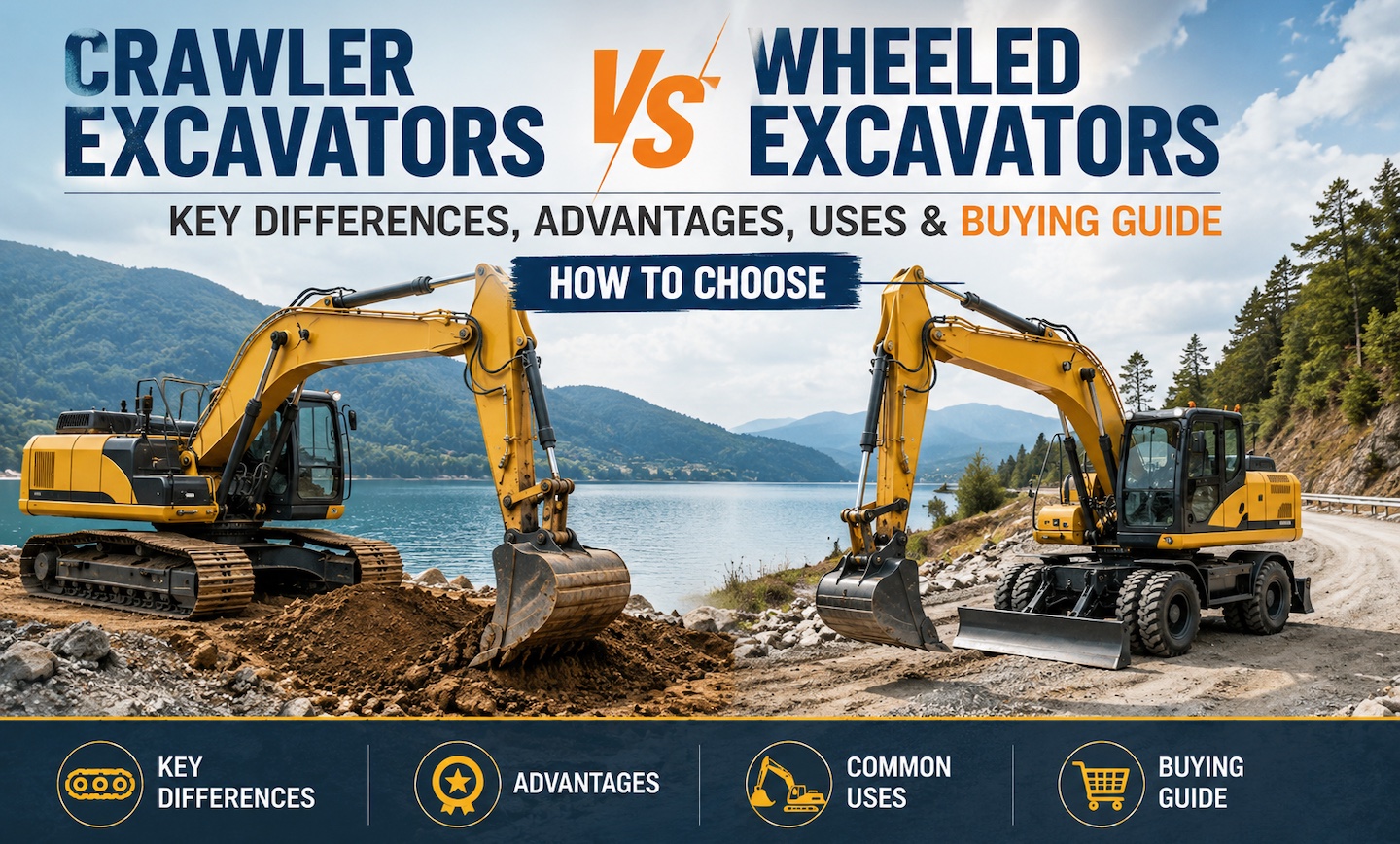
Crawler Excavators vs Wheeled Excavators: Key Differences, Advantages, Uses & Buying Guide
How to choose the right machine?When selecting an excavator for a construction project, one of the most important decisions is choosing between a crawler excavator and a wheeled excavator. Both types are widely used in construction, infrastructure, and urban development, but they are designed for very different working conditions.
Understanding their differences can help contractors reduce operating costs, improve efficiency, and choose the right machine for long-term productivity.
1. What Is a Crawler Excavator?
A crawler excavator is a type of heavy construction machine that moves on two continuous tracks instead of wheels. These tracks distribute the machine’s weight evenly across the ground, allowing it to operate on soft, uneven, or challenging terrain.
Crawler excavators are the most commonly used type in global construction projects, especially in mining, earthmoving, road building, and large-scale excavation work.
Key characteristics:
Steel or rubber tracks for movement
High stability on rough terrain
Strong digging force and breakout power
Suitable for heavy-duty operations
Because of their stability and traction, crawler excavators are often used in demanding environments where wheeled machines cannot perform effectively.
2. What Is a Wheeled Excavator?
A wheeled excavator is equipped with rubber tires instead of tracks. It is designed for mobility on paved roads and relatively flat surfaces.
Unlike crawler excavators, wheeled excavators are optimized for speed and flexibility rather than maximum traction.
Key characteristics:
Rubber tires for road mobility
Faster travel speed between job sites
Better suited for urban environments
Easier to transport without trailers in some cases
Wheeled excavators are commonly used in city construction, municipal maintenance, road repair, and utility projects.
3. Mobility and Transportation
One of the biggest differences between crawler and wheeled excavators is mobility.
Crawler Excavators:
Crawler machines move slowly and are not designed for long-distance travel. When moving between job sites, they usually require a trailer or low-bed truck.
Pros: excellent off-road mobility
Cons: slow travel speed, transport required
Wheeled Excavators:
Wheeled machines can travel directly on roads at relatively higher speeds.
Pros: fast relocation between sites
Cons: limited off-road capability
In urban or multi-site projects, wheeled excavators often provide better operational efficiency due to their mobility advantage.
4. Stability and Working Performance
Crawler Excavators:
Crawler excavators offer superior stability due to their wide track base and low ground pressure. This makes them ideal for:
Deep excavation
Heavy lifting
Sloped or muddy terrain
Mining operations
They remain stable even under high load conditions.
Wheeled Excavators:
Wheeled excavators have lower ground contact stability compared to crawler types. They may require outriggers or stabilizers during digging operations.
They are best used for:
Light to medium excavation
Roadside maintenance
Flat surface projects
If stability and digging force are top priorities, crawler excavators are the better choice.
5. Working Environments
Choosing the right excavator largely depends on the job site conditions.
Best applications for crawler excavators:
Mining and quarrying
Earthmoving projects
Forestry operations
Construction in muddy or uneven terrain
Large infrastructure projects
Best applications for wheeled excavators:
Urban construction
Road maintenance
Utility and pipeline work
Municipal engineering
Short-distance multi-site projects
Terrain condition is one of the most important decision factors.
6. Fuel Efficiency and Operating Cost
Crawler Excavators:
Crawler excavators generally consume more fuel due to:
Heavier structure
Higher digging resistance environments
Continuous track friction
However, they provide higher productivity in tough conditions.
Wheeled Excavators:
Wheeled excavators tend to be more fuel-efficient in urban or light-duty work because:
Less rolling resistance
Faster movement reduces idle time
Lower undercarriage wear in paved environments
In smooth terrain, wheeled excavators can significantly reduce operating cost per hour.
7. Maintenance and Durability
Crawler Excavators:
Tracks require regular maintenance or replacement
Undercarriage wear is higher in rocky terrain
More durable in harsh working environments
Wheeled Excavators:
Tires are easier and cheaper to replace
Lower undercarriage wear
More sensitive to rough terrain damage
Maintenance cost depends heavily on usage environment.
8. Productivity Comparison
Productivity is not just about power—it is about matching machine type with job conditions.
Crawler excavators deliver higher productivity in heavy-duty excavation
Wheeled excavators deliver higher efficiency in fast-moving, multi-location jobs
For example:
In a mining site → crawler excavator is significantly more productive
In a city road repair project → wheeled excavator saves time and logistics cost
9. Cost Comparison (Purchase and Lifecycle)
Crawler Excavators:
Higher purchase cost (generally)
Higher transport cost
Higher durability in harsh jobs
Wheeled Excavators:
Slightly higher initial cost in some markets
Lower transport and logistics cost
Lower maintenance in urban use
Total cost of ownership depends on application, not just purchase price.
10. Which One Should You Choose?
The decision should be based on real working conditions:
Choose a crawler excavator if:
You work on rough or uneven terrain
You need strong digging power
You operate in mining, quarry, or heavy construction
Stability is critical
Choose a wheeled excavator if:
You work mainly in cities or paved roads
You need frequent relocation
Your projects are small to medium scale
Speed and flexibility are important
11. Final Thoughts
Crawler and wheeled excavators are not competitors—they are tools designed for different engineering needs.
Crawler excavators focus on power, stability, and rough terrain capability
Wheeled excavators focus on mobility, speed, and urban efficiency
Choosing the right type directly impacts project efficiency, operating cost, and long-term profitability.
For contractors and equipment buyers, understanding these differences is essential before making any investment decision.
2026-07-03